The troops are in rear-area camps and camouflaged trenches well below the snow-line. Josef, with his staff, walks around the area, completely informally, talking to the occasional soldier. He watches ...
Two aircraft, described as "hydroaeroplanes", are on the water. The first, a monoplane, looks like an adaptation of the Morane-Saulnier H Type, the second a variant on the Farman M Type design. The mo...
I. An officer shows the correct methods of mounting a horse, sitting at attention and at ease, trotting, the extended trot, leading off alternate legs and a dressage test. Following this, other riders...
Wrecked houses, the result of shell-damage, are shown in the suburbs which were part of the French position. A German trench captured by the French is also shown.
The French forces in the Battle ...
The sailors who brought the coffins up the Adriatic coast to Trieste act as escorts as the hearses and state coaches, covered with flowers, make their procession through the streets. The procession ar...
Venizelos, with Generals Gérome and Zymbrakakis (?) inspects French troops, then a Greek regiment, talking with some of the officers and men.
Newsreel item on President Venizelos visiting Greek ...
The internees play together, tossing corks into a circle to pass the time.The ambulances pull up at the military hospital and a stretcher is taken out of one with a wounded soldier on it. One of the a...
The villa of Berti Soderini at Nervesca, containing frescoes by Paolo Veronese, shows extensive damage as the result of an Austrian bombardment, "the Hun touch".
Newsreel item on damage done by A...
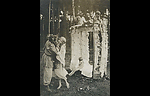
Rochus Gliese, Paul Wegener (from left to right)
Still with Lyda Salmonova, Paul Wegener (on the right, front)
Arthur Ehrens, Paul Wegener (from left to right)
Paul Wegener, Hedwig Gutzeit
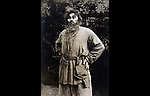
Paul Wegener
Paul Wegener, Lyda Salmonova
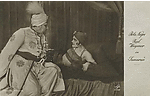
Paul Wegener, Pola Negri
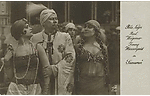
Pola Negri, Paul Wegener, Jenny Hasselquist (from left to right)
O. Verf.. „Kino und Kirche.“ Bild & Film. Zeitschrift für Lichtbilderei und Kinematographie III, 3/4 (1913/1914): 73-74. Beschlüsse der Fuldaer Bischofskonferenz von 20.8.1913. Schulpflichtigen ...
Felix, F.. „Die Kinematographie der Töne.“ Bild & Film. Zeitschrift für Lichtbilderei und Kinematographie III, 3/4 (1913/1914): 78-79. Meldung über erste Versuche, Film-und Tonaufnahmen zu sync...
W.R.. „Historische Filme.“ Bild & Film. Zeitschrift für Lichtbilderei und Kinematographie III, 3/4 (1913/1914): 86. Der Rezensent führt den Film als Beispiel dafür an, dass die Filmindustrie mi...
Hellwig, Albert. „Die Plakatzensur in Preussen.“ Bild & Film. Zeitschrift für Lichtbilderei und Kinematographie III,5 (1913/1914): 104-106. Rekapitulierung der Rechtslage zu Filmplakaten.
O. Verf.. „Preußischer Ministerialerlaß über das Plakat- und Reklamewesen.“ Bild & Film. Zeitschrift für Lichtbilderei und Kinematographie III, 5 (1913/1914): 111-112. Filmplakate bedürfen de...
Warstat, W.. „Kino und Schule. Von Prof. Dr. A. Sellmann.“ Bild & Film. Zeitschrift für Lichtbilderei und Kinematographie III,5 (1913/1914): 116-117. Der Rezensent sieht die Verwendung von Filmen...
Fritze, G.A.. „Die Kinematographie im Dienste der Industrie.“ Bild & Film. Zeitschrift für Lichtbilderei und Kinematographie III,6 (1913/1914): 124-128. Erörterung der bereits erfolgten Verwendu...
Felix, F.. "Rektor Lemkes „Reichsausschuß“." Bild & Film. Zeitschrift für Lichtbilderei und Kinematographie III, 6 (1913/1914): 134-137. Bericht über einen Reichsausschuss für wissenschaftlich...