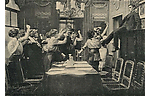
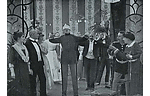
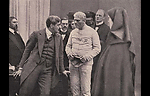
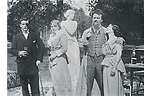
I. Women making and shaping spade cutters for guns (endless repetition) using heavy plant, a factory in Britain, 1917 or 1918.II. Women making internal combustion engines, including some tank engines,...
A chubby soldier, in close-up, cuddles two lambs. Another feeds chickens from a metal plate, letting one stand and balance on the plate. One of the men puts on a German helmet and trench body armour, ...
General Sir Herbert Plumer, GOC Second Army (back to camera) presents medals to a line of four British nurses in a field near Blendecques, Western Front, 26 June 1918.
The party, in informal dress, walks in the gardens of the house. Beaverbrook's young daughter and two smaller sons (wearing kilts) are prominent. The group poses on the terrace steps, followed by a se...
The film stresses local personalities (some mentioned by name) and details of local life. At the village pump a notice-board is used for newspapers to spread news of the war. Children play round a may...
The Portuguese officers pose with their British liaison and training staff. A parade ground marchpast, possibly gunners doing formation drill. Semaphore practice on the parade ground. Gun teams practi...
The sports are held by convalescent soldiers wearing hospital blue uniforms, and by nurses. A man and woman in civilian clothes, well-dressed, throw sweets to the crowd of convalescents. The sports co...
A pan of the assembly camp in Egypt, tented and open, where the "recruits of all provinces dressed in various types of garb" arrive and are given Egyptian Labour Corps uniform, "the men are delighted ...
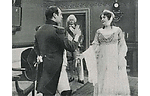
Still from "Der Film von der Königin Luise. 3. Abteilung: Die Königin der Schmerzen"
Still from "Gebrochene Schwingen"
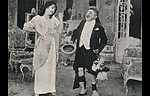
Still from "Das Liebesbarometer"
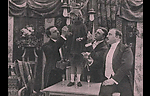
Still from "Ein Mädchen zu verschenken"
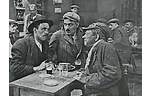
Still from "Paragraph 80, Absatz II"
Still from "Reingefallen"
Still from "Schuldig"
Still from "Die Statue"
Spectator. "Der heutige Stand der Kinoreform." Bild & Film. Zeitschrift für Lichtbilderei und Kinematographie III, 3/4 (1913/ 1914): 49-56. Der Autor warnt vor den Gefahren, die vom Kino ausgingen un...
Häfker, Hermann. "Sind die 'kleinen' Kinotheater der Reform schädlich?" Bild & Film. Zeitschrift für Lichtbilderei und Kinematographie III, 3/4 (1913/1914): 58-60. Häfker geht davon aus, dass die ...
Schumacher, Carl. "Zur 'Kinodramatik'." Bild & Film. Zeitschrift für Lichtbilderei und Kinematographie III, 3/4 (1913/1914): 63-64. Schumacher stellt die Abwesenheit von Dialogen als das Hauptproblem...
O. Verf.. "Kino-Kritik." Bild & Film. Zeitschrift für Lichtbilderei und Kinematographie III, 3/4 (1913/1914): 68-69. Obwohl immer wieder Forderungen nach der Hebung des Niveaus im Kino laut würden, ...
O. Verf.. "Das Kinoplakat." Bild & Film. Zeitschrift für Lichtbilderei und Kinematographie III, 3/4 (1913/1914): 70. Meldung über die zunehmende Hebung des Niveaus von Kinoplakaten. Statt auf grelle...
O. Verf.. "Die Kinematographie auf dem 85. Naturforschertag in Wien." Bild & Film. Zeitschrift für Lichtbilderei und Kinematographie III, 3/4 (1913/1914): 70-71. Meldung über den Einsatz von Filmen ...
O. Verf.. „Polizeiverordnung für das Rheinland.“ Bild & Film. Zeitschrift für Lichtbilderei und Kinematographie III, 3/4 (1913/1914): 72-73. Meldung über den Einsatz von Filmen als illustrieren...
O. Verf.. „Ein Kinematographengesetz in Württemberg.“ Bild & Film. Zeitschrift für Lichtbilderei und Kinematographie, III, 3/4 (1913/1914): 73. Jeder Film, der öffentlich vorgeführt werde, mü...