The film opens with Oxford Street in London and declares that "luxury shopping" is not helping the war effort. This is contrasted with the ways in which women do help: a mother looking after her two s...
The film opens with a German jackboot across the map of Alsace-Lorraine. An old couple in Alsatian costume read the news of the annexation and bemoan their fate while German officers strut outside the...
The young woman leaves her terraced house (section tinted blue) at 5am and takes the train to the factory (tinting ends). In the locker room she and the others change into overalls and boots, and cloc...
(Reel 1) "Mr Briton" is a pillar of the community, with a wife and daughter, a cook, a maid and a gardener. His son Tom is with the Army in France and his daughter Mabel is an Inspector of Female Labo...
The raw material - close-up of a piece of concrete held in the hand. Travelling medium shot from a train pulling into a siding at the shipyard - seven months ago the area "consisted of open fields". P...
Harbour scene with mountains in the background. Steam launch comes alongside towing five ship's boats crowded with ratings and marines. Local people watch as the sailors disembark. Crowds pass waterfr...
Medium shot view fine on starboard quarter of HMS St Vincent with main yards set. Mainsail clewed up. Main topgallant sail furled in a body. Main topsail scandalised - yard lowered and reef tackle hau...
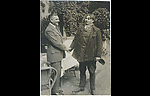
The camera position looks over the Queen Elizabeth's quarterdeck towards the stern. Wilson comes up the ship's ladder and shakes hands with Beatty. It is an informal, working meeting. The rest of the ...
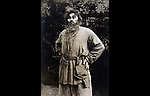
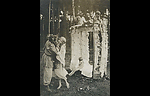
Rochus Gliese, Paul Wegener (from left to right)
Still with Lyda Salmonova, Paul Wegener (on the right, front)
Arthur Ehrens, Paul Wegener (from left to right)
Paul Wegener, Hedwig Gutzeit
Paul Wegener
Paul Wegener, Lyda Salmonova
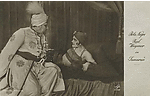
Paul Wegener, Pola Negri
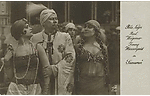
Pola Negri, Paul Wegener, Jenny Hasselquist (from left to right)
Spectator. "Der heutige Stand der Kinoreform." Bild & Film. Zeitschrift für Lichtbilderei und Kinematographie III, 3/4 (1913/ 1914): 49-56. Der Autor warnt vor den Gefahren, die vom Kino ausgingen un...
Häfker, Hermann. "Sind die 'kleinen' Kinotheater der Reform schädlich?" Bild & Film. Zeitschrift für Lichtbilderei und Kinematographie III, 3/4 (1913/1914): 58-60. Häfker geht davon aus, dass die ...
Schumacher, Carl. "Zur 'Kinodramatik'." Bild & Film. Zeitschrift für Lichtbilderei und Kinematographie III, 3/4 (1913/1914): 63-64. Schumacher stellt die Abwesenheit von Dialogen als das Hauptproblem...
O. Verf.. "Kino-Kritik." Bild & Film. Zeitschrift für Lichtbilderei und Kinematographie III, 3/4 (1913/1914): 68-69. Obwohl immer wieder Forderungen nach der Hebung des Niveaus im Kino laut würden, ...
O. Verf.. "Das Kinoplakat." Bild & Film. Zeitschrift für Lichtbilderei und Kinematographie III, 3/4 (1913/1914): 70. Meldung über die zunehmende Hebung des Niveaus von Kinoplakaten. Statt auf grelle...
O. Verf.. "Die Kinematographie auf dem 85. Naturforschertag in Wien." Bild & Film. Zeitschrift für Lichtbilderei und Kinematographie III, 3/4 (1913/1914): 70-71. Meldung über den Einsatz von Filmen ...
O. Verf.. „Polizeiverordnung für das Rheinland.“ Bild & Film. Zeitschrift für Lichtbilderei und Kinematographie III, 3/4 (1913/1914): 72-73. Meldung über den Einsatz von Filmen als illustrieren...
O. Verf.. „Ein Kinematographengesetz in Württemberg.“ Bild & Film. Zeitschrift für Lichtbilderei und Kinematographie, III, 3/4 (1913/1914): 73. Jeder Film, der öffentlich vorgeführt werde, mü...