One of the officers plays briefly outdoors with a parrot on its perch. Two officers with a theodolite on a tripod survey the area. Indoors a RNVR lieutenant makes fine adjustments to a set of scales b...
The airship is shown nose-out in its hangar with the frame of another rigid airship being built beside it. The groundcrew leads the R27 out to its launch ground. The camera gets in close to show the l...
The British patrol lies in a slit trench beside its Rolls-Royce Silver Ghost armoured car. The captured spy sits on top of the car's bonnet and is questioned by an interpreter.
I. Newsreel item o...
The film shows sailors carrying stretchers with survivors from the sinking through the streets of an Irish village. The formal funeral of those who drowned in the sinking, also in Ireland. A close-up ...
I. Newsreel item on Sir Edward Kemp, Canada's Minister of Militia, working at his desk and in profile against a window, January 1918. II. Newsreel item on US Ambassador Walter Page opening a YMCA for ...
The first fire is in London, "Britain's largest timberyard" burning. The second fire is an asphalt works in New Jersey, with oil tanks and barrels ablaze. The third conflagration is at "Saint Margret'...
The women work in a hangar assembling the aircraft. Some of the women are in the Women's Army Auxiliary Corps. They make the wooden frames for the aircraft wings, then attach the fabric. A group of th...
Spanish language version of a newsreel item on British horsed transport detouring round the dry Wadi Hersi, north of Gaza, since the retreating Turks have blown the bridge, Palestine, November 1917.
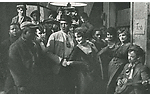
Still with Colette Corder (front, in the middle)
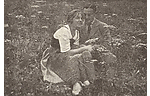
Ossi Oswalda, Julius Dewald
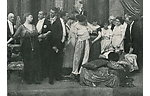
Still from "Die rätselhafte Sphinx"
Still from "Der Schwur der Renate Rabenau"
Still from "Störe nicht die Flitterwochen"
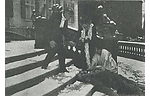
Still with Carl de Vogt (on the left, sitting)
Still with Carl Clewing (front, on the left)
Still from "Die Topharmumie"
Oscar Geller, Detektiv-Filme, Der Kinematograph, 593, (1918), S. 21-25. Eröterung der Krimiwelle. Man könne Krimis nicht einfach als Schund abtun. Auch wenn viele der frühen Krimis, maßgeblich aus...
Poldi Schmidl, Der Kinobesitzer als Staatsbeamter, Der Kinematograph, 607, (1918). Angesichts der geplanten Konzessionspflicht für Kinobesitzer wird die Möglichkeit einer Verstaatlichung der Filmind...
Argus, Neuheiten auf dem Berliner Filmmarkte, Der Kinematograph, 614, (1918). "Kinder der Liebe" als Tendenz- und Aufklärungsfilm bezeichnet, dessen Absicht überzeuge. "Der Gefangene von Dahomey" se...
Egon Jacobsohn, Ferdinand Lassalle, Der Kinematograph, 615, (1918), S. 18-30. Bericht von der Uraufführung in Berlin. Die Aufführung sei ein voller Erfolg gewesen, zumal es besonders gut in die Zeit...
Deutsche Lichtbild Gesellschaft e.V., Der Friedensreiter, Der Kinematograph, 618, (1918), S.22-23.
Emil Perlmann, Wenn die Waffen ruhen...!, Der Kinematograph, 619, (1918). Erörterung der Lage der Filmindustrie angesichts des greifbaren Kriegsendes. Die Filmindustrie müsse den Kampf gegen die Zen...
Der deutsche Film für das Ausland, Der Kinematograph, 620, (1918). Es sei Aufgabe der deutschen Filmindustrie, den negativen Vorstellungen über Deutschland, die im Ausland im Krieg verbreitet worden...
Universum Filmverleih, Die Waffen nieder, Der Kinematograph, 620, (1918), S. 28-33.