In Blérancourt, a little town in Aisne where the Civil Security has been set up on the ruins of the chateau, American women raise the American flag. Mr. Fernand David, the Minister of Agriculture, an...
Jules-Louis Breton and the members of the Invention Department Studies and Technical Experiments Section attend flame-thrower tests in a field and in a trench.
A plane drops bombs from different altitudes to study the trajectory of the projectiles and calculate the freefall time.
After five years of war and hardship, young people need a distraction from the dreary atmosphere of the devastated villages. In Aisne, the reconstruction is slow. The American Committee decides to adv...
In front of Landricourt's temporary church, a crowd attends the baptism of a bell that will replace the one destroyed during WWI. The new bell was donated by the Poetry Society of America in memory of...
In June 1919 at the Mailly military camp, tanks carry out traction tests on rough terrain while Marshal Pétain looks on.
Lieutenant Lender and Paul Heldelberg present the "Piloteur" to the Invention Department's Technical Aeronautic Committee. Using this device, which is anchored to the ground, student pilots can learn...
In a field, soldiers, officers, civilians, and Jules-Louis Breton, members of the Invention Department Committee, study different types of machine guns designed to be fired at tanks.
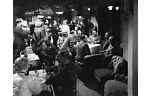
Wide shot of a café filled with Austrian officers. Some are sitting at tables and others are standing in the background, most of them hold glasses in their hands. Nurse Mathilde (actress: Adina Mandl...
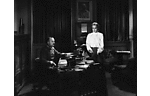
Wide shot of an office. Dr. Šrámek (actor: František Smolík) in the uniform of an Austrian officer sits at a desk and gazes at the nurse Mathilde (actress: Adina Mandlová), who is standing on the...
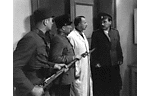
Medium shot of an Austrian soldier standing with an Austrian colonel (Jaroslav Marvan), Dr. Šrámek (František Smolík), and Lieutenant Rjepkin (Vladimír Borský). The soldier is pointing his bayon...
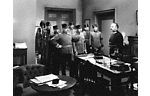
Wide shots of an office. A group of seven Austrian officers (fifth from left is actor Jaroslav Marvan) stand at the door and look at Dr. Šrámek (actor: František Smolík), who is standing behind a ...
Wide shot of a hospital room with a group of standing patients and three military privates. One of the privates, infantryman Tlamicha (actor: Theodor Pištěk), stands in the middle and conducts as th...
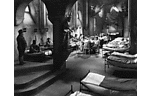
Wide shot of a church interior that has been converted into a military hospital. Wounded soldiers sit or lie on hospital beds lined up along the walls. Other patients sit at the two tables standing in...
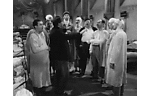
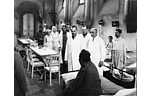
Wide shot of a hospital room where doctors are making rounds. On the left are tables with bread and carafes of water. Chairs are standing around the tables. Five doctors stand in the middle of the roo...
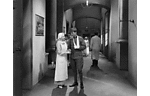
Wide shot of a hospital corridor. Nurse Tonička (actress: Truda Grosslichtová) stands in the middle of the corridor clasping hands with Corporal Bartoněk (actor: Jiří Vondrovič), whose other arm...
Spectator. "Der heutige Stand der Kinoreform." Bild & Film. Zeitschrift für Lichtbilderei und Kinematographie III, 3/4 (1913/ 1914): 49-56. Der Autor warnt vor den Gefahren, die vom Kino ausgingen un...
Häfker, Hermann. "Sind die 'kleinen' Kinotheater der Reform schädlich?" Bild & Film. Zeitschrift für Lichtbilderei und Kinematographie III, 3/4 (1913/1914): 58-60. Häfker geht davon aus, dass die ...
Schumacher, Carl. "Zur 'Kinodramatik'." Bild & Film. Zeitschrift für Lichtbilderei und Kinematographie III, 3/4 (1913/1914): 63-64. Schumacher stellt die Abwesenheit von Dialogen als das Hauptproblem...
O. Verf.. "Kino-Kritik." Bild & Film. Zeitschrift für Lichtbilderei und Kinematographie III, 3/4 (1913/1914): 68-69. Obwohl immer wieder Forderungen nach der Hebung des Niveaus im Kino laut würden, ...
O. Verf.. "Das Kinoplakat." Bild & Film. Zeitschrift für Lichtbilderei und Kinematographie III, 3/4 (1913/1914): 70. Meldung über die zunehmende Hebung des Niveaus von Kinoplakaten. Statt auf grelle...
O. Verf.. "Die Kinematographie auf dem 85. Naturforschertag in Wien." Bild & Film. Zeitschrift für Lichtbilderei und Kinematographie III, 3/4 (1913/1914): 70-71. Meldung über den Einsatz von Filmen ...
O. Verf.. „Polizeiverordnung für das Rheinland.“ Bild & Film. Zeitschrift für Lichtbilderei und Kinematographie III, 3/4 (1913/1914): 72-73. Meldung über den Einsatz von Filmen als illustrieren...
O. Verf.. „Ein Kinematographengesetz in Württemberg.“ Bild & Film. Zeitschrift für Lichtbilderei und Kinematographie, III, 3/4 (1913/1914): 73. Jeder Film, der öffentlich vorgeführt werde, mü...