The Higher Invention Committee examines the Chilowsky shrapnel to increase the power of projectiles.
A group of officers and civilians attends the assembly and test-firing of the 240mm Trench Mortar.
The department of inventions, studies, and technical experiments on powders and explosives carries out test explosions off Toulon. The technical and scientific team prepares the experiment aboard a bo...
Soldiers from the Russian army have set up an encampment and are eating on the outskirts of a forest, in thick snowfall. Near a village, cannons are fired. Men, women, and children, on their way into ...
May 1916. A large detachment of prisoners arrives at the Souilly (Meuse) camp. The detachment stands out, with prisoners from Alsace, Poland and Denmark. Featuring: A panorama of the camp and its wall...
During World War I, in Reval on November 10, 1915, Tsar Nicolas II inspects a submarine crew.
November 11, 1915, in Riga (?), Tsar Nicolas II inspects regiments of Siberian skirmishers who then march past the Emperor, performing a few acrobatics with their horses. At the end, the imperial fami...
Aboard a small boat pulled by a tugboat in the Toulon harbor, Jules-Louis Breton and some members of the Invention Department Technical Engineering Committee try out underwater goggles to find a subma...
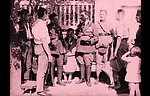
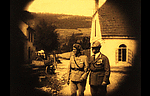
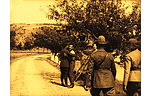
Reunion of families after war. In the middle stand Tomeš, Janda and Bárta in uniforms of volunteers. Women sit behind and sons talk with fathers.
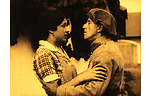
Volunteer Bárta (laborer) encounters his wife.
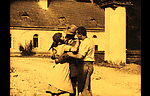
Volunteer Janda (smith) in Italian uniform encounters his family after the end of the war.
Janda´s son in the apron and volunteer Janda in Italian uniform.
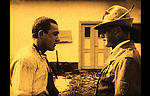
From the left: Volunteer Bárta in French uniform, volunteer Janda in Italian uniform.
Tomeš encounters his wife and son after the return from the war. Tomeš hugs his son. His wife stands nearby and smiles at Janda and Bárta.
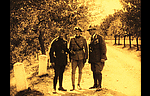
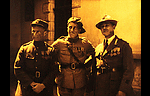
From the left: Tomeš (Russian uniform), Bárta (French uniform) and Janda (Italian uniform). Volunteers rest during their coming home.
From the left: Tomeš (Russian uniform), Bárta (French uniform) and Janda (Italian uniform).
O. Verf.. „Kino und Kirche.“ Bild & Film. Zeitschrift für Lichtbilderei und Kinematographie III, 3/4 (1913/1914): 73-74. Beschlüsse der Fuldaer Bischofskonferenz von 20.8.1913. Schulpflichtigen ...
Felix, F.. „Die Kinematographie der Töne.“ Bild & Film. Zeitschrift für Lichtbilderei und Kinematographie III, 3/4 (1913/1914): 78-79. Meldung über erste Versuche, Film-und Tonaufnahmen zu sync...
W.R.. „Historische Filme.“ Bild & Film. Zeitschrift für Lichtbilderei und Kinematographie III, 3/4 (1913/1914): 86. Der Rezensent führt den Film als Beispiel dafür an, dass die Filmindustrie mi...
Hellwig, Albert. „Die Plakatzensur in Preussen.“ Bild & Film. Zeitschrift für Lichtbilderei und Kinematographie III,5 (1913/1914): 104-106. Rekapitulierung der Rechtslage zu Filmplakaten.
O. Verf.. „Preußischer Ministerialerlaß über das Plakat- und Reklamewesen.“ Bild & Film. Zeitschrift für Lichtbilderei und Kinematographie III, 5 (1913/1914): 111-112. Filmplakate bedürfen de...
Warstat, W.. „Kino und Schule. Von Prof. Dr. A. Sellmann.“ Bild & Film. Zeitschrift für Lichtbilderei und Kinematographie III,5 (1913/1914): 116-117. Der Rezensent sieht die Verwendung von Filmen...
Fritze, G.A.. „Die Kinematographie im Dienste der Industrie.“ Bild & Film. Zeitschrift für Lichtbilderei und Kinematographie III,6 (1913/1914): 124-128. Erörterung der bereits erfolgten Verwendu...
Felix, F.. "Rektor Lemkes „Reichsausschuß“." Bild & Film. Zeitschrift für Lichtbilderei und Kinematographie III, 6 (1913/1914): 134-137. Bericht über einen Reichsausschuss für wissenschaftlich...