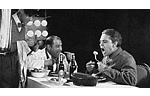
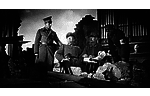
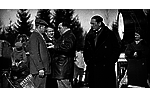
(Reel 1) Off the British coast, U-boat 32 attacks merchant ships. The German captain, Stackmeyer, is saluted by his Admiral, who warns that the blockade of Britain will be tightened; later, the U-boat...
A collection of fragments of British and Australian aviation film of the First World War period.
Subtitled "The work of the Department of the Director General Voluntary Organisations including the Camps Library". Introductory shot of the Director General Sir Edward Ward seated in his office in Sc...
VICTORY - GOD BLESS THE BRITISH ARMY THAT HAS SAVED OUR HOMES AND OUR ALL!: Stock footage of mortar launcher, bi-plane, and tanks. AND OUR INDOMITABLE SONS OF THE SEA WHO HAVE SAVED US AND OUR ALLIES ...
The assembly groups the films into episodes as follows: (Reel 1) Salonika, the voyage to Egypt, the ceremony of the drums, the aeroplane flight; (Reel 2) the horse show, scenes at a 'cactus patch' loc...
Four reels of very jumbled material, mainly out-of-focus or of poor quality. The first reel is mainly of fragments from the Western Front 1916-1918 taken by British official cameramen, the remainder f...
The film appears to be of the intervention in North Russia, but varies in quality from slightly out of focus to completely blurred.
Blurred and unviewable film of the British intervention in Nort...
The regiments are as follows. The Civil Service Rifles (a battalion of the Royal Fusiliers). The London Scottish (1/14th Battalion, the London Regiment). Pipers of the Argyll and Sutherland Highlander...
Joe May (second from the left), Gustav Fröhlich (third from the left) on the set
Szene aus "Westfront 1918"
G.W. Pabst (Mitte), André Saint-Germain (rechts) (Dreharbeiten)
Fritz Arno Wagner, Fritz Métain (links), G.W. Pabst (Mitte), André Saint-Germain (1.v.r.) (Dreharbeiten)
Szene aus "Westfront 1918"
Szene aus "Das Geheimnis des Ingenieurs Branting"
Oscar Geller, Detektiv-Filme, Der Kinematograph, 593, (1918), S. 21-25. Eröterung der Krimiwelle. Man könne Krimis nicht einfach als Schund abtun. Auch wenn viele der frühen Krimis, maßgeblich aus...
Poldi Schmidl, Der Kinobesitzer als Staatsbeamter, Der Kinematograph, 607, (1918). Angesichts der geplanten Konzessionspflicht für Kinobesitzer wird die Möglichkeit einer Verstaatlichung der Filmind...
Argus, Neuheiten auf dem Berliner Filmmarkte, Der Kinematograph, 614, (1918). "Kinder der Liebe" als Tendenz- und Aufklärungsfilm bezeichnet, dessen Absicht überzeuge. "Der Gefangene von Dahomey" se...
Egon Jacobsohn, Ferdinand Lassalle, Der Kinematograph, 615, (1918), S. 18-30. Bericht von der Uraufführung in Berlin. Die Aufführung sei ein voller Erfolg gewesen, zumal es besonders gut in die Zeit...
Deutsche Lichtbild Gesellschaft e.V., Der Friedensreiter, Der Kinematograph, 618, (1918), S.22-23.
Emil Perlmann, Wenn die Waffen ruhen...!, Der Kinematograph, 619, (1918). Erörterung der Lage der Filmindustrie angesichts des greifbaren Kriegsendes. Die Filmindustrie müsse den Kampf gegen die Zen...
Der deutsche Film für das Ausland, Der Kinematograph, 620, (1918). Es sei Aufgabe der deutschen Filmindustrie, den negativen Vorstellungen über Deutschland, die im Ausland im Krieg verbreitet worden...
Universum Filmverleih, Die Waffen nieder, Der Kinematograph, 620, (1918), S. 28-33.